Laser " certifications " are useless.
- Matt Brown
- Jul 15
- 5 min read

What Laser Certifications Actually Mean ( and its not much )
FDA, CE, TGA, TÜV, MDSAP and the myth of "Medsafe Approved"
A certificate may show that a specific regulatory requirement has been met. It does not prove that a laser is premium quality, performs well or has been physically tested by a government regulator.
Beauty laser brochures are covered in impressive acronyms: FDA, CE, TGA, TÜV, MDSAP and often "Medsafe Approved". Clinic owners are encouraged to see these as gold stars for quality and safety.
That is the problem. These systems all have a purpose, but none is a simple quality rating. They do not tell you whether the machine uses good components, delivers accurate energy, cools properly or will still perform after thousands of shots.
Here is what each one actually means.
1. Medsafe: there is no "Medsafe Approved" laser
Medsafe clearly states that WAND is not an approval system. WAND is the New Zealand database used to record medical devices and their local sponsors.
The supplier enters the device information. Medsafe does not test the laser or assess its quality, safety, effectiveness or performance before it is notified.
WAND is useful for identifying suppliers and managing safety issues or recalls. But being listed does not mean the device is approved or endorsed. Calling a device "Medsafe Approved" is simply wrong.
2. FDA: the FDA generally does not see or test the laser
This is where buyers are often given the wrong impression. Most aesthetic devices that need US clearance use the FDA 510(k) pathway.
The manufacturer, or a consultant acting for them, submits a large evidence file. It may contain electrical-safety reports, EMC testing, software information, performance testing and sometimes clinical data. Some reports may come from independent laboratories, but the evidence is submitted by or for the manufacturer.
FDA staff normally do not receive the laser, turn it on, fire it or measure its output. They are not flying to China to inspect the factory before clearing each machine. The FDA itself says it does not typically perform a pre-clearance factory inspection for a 510(k).
Instead, the FDA reviews the submitted evidence and decides whether the device is substantially equivalent to an existing legally marketed device. The FDA can ask questions, request more evidence, inspect the factory later and take enforcement action if problems arise. But the original clearance is normally a document-and-evidence review, not hands-on testing by the FDA.
Also watch the wording. "FDA registered" is not FDA clearance. The FDA says registration and device listing do not mean approval, clearance or authorisation. The FDA does not issue factory registration certificates.
A real 510(k) clearance is meaningful for selling the named device in the US. It does not prove superior build quality, long-term reliability or that every unit leaving the factory matches the tested design.
3. CE and Medical CE
CE is a European market-access mark. It means the manufacturer declares that the product meets the EU requirements that apply to it.
For lower-risk devices, this may be self-declared. For higher-risk medical and aesthetic devices, a Notified Body must review parts of the manufacturer's quality system and technical documentation.
That still does not mean an EU government department has tested every machine. A generic CE electrical or EMC report is also not the same as complete Medical CE documentation under the EU Medical Device Regulation.
Ask for the exact Declaration of Conformity, manufacturer, model, regulation, Notified Body number and certificate scope. A CE logo on the back of a machine proves very little by itself.
4. TGA and ARTG inclusion
The TGA regulates medical devices in Australia. Devices are generally included in the Australian Register of Therapeutic Goods through an Australian sponsor.
The process relies heavily on manufacturer conformity evidence and recognised overseas regulatory evidence. Some applications are audited and the TGA can request more information, inspect and take post-market action.
Zenith has gone through this process through Zenith Laser Australia. It is detailed, expensive and document-heavy. But the TGA does not take every laser into a government workshop, pull it apart and test every setting before ARTG inclusion.
An ARTG entry is meaningful for Australian supply. It is not proof that the machine is premium quality, and it is not a New Zealand approval.
5. TÜV: ask, "Certified for what?"
TÜV is not a government regulator or a single certificate. TÜV companies are independent testing, inspection and certification businesses.
A TÜV company might test a representative machine, audit an ISO 13485 quality system, act as an EU Notified Body or issue a report against a particular standard. What they physically see depends entirely on the service performed.
So "TÜV certified" is an incomplete claim. Ask which TÜV company, which standard, which factory, which model, what scope and what expiry date. A TÜV logo with no supporting document is just a logo.
6. MDSAP: the factory system, not the laser
MDSAP is a regulatory audit of a medical-device manufacturer's quality-management system. It looks at how the factory controls design, production, suppliers, complaints and corrective actions.
This can be useful evidence that the manufacturer has a structured quality system. But it is not product approval. MDSAP auditors do not test the clinical performance of every laser model or inspect every unit leaving the factory.
The real issue: does your machine match the evidence?
Testing is normally performed on a defined design and representative samples. A responsible manufacturer then keeps production consistent through approved components, suppliers and change control.
Problems arise when components, software, power supplies, lamps, capacitors, cooling systems or handpieces are changed without proper review. The certificate may be real, but the machine delivered to the clinic may no longer match the device behind it.
That is why a certificate should be the start of your checks, not the end.
What a clinic should check
Does the certificate name the exact manufacturer and model being sold?
Can the clearance or certificate number be verified with the issuing body?
Does the scope cover the actual treatments being advertised?
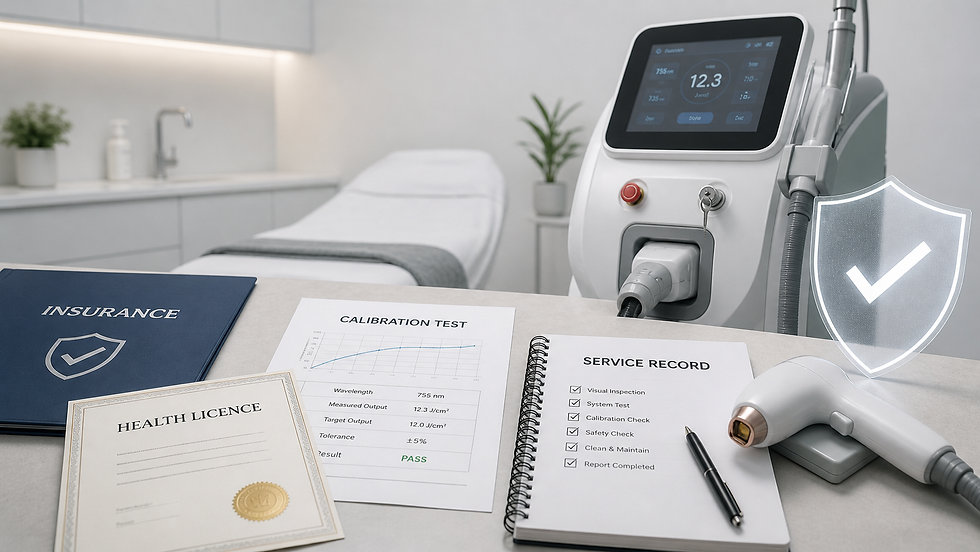
Can the supplier verify the output and calibration of the machine being delivered?
Who services it in New Zealand, and are parts held here?
Is proper clinical training, warranty support and long-term technical backup included?
The Zenith verdict
These certifications are not completely meaningless. They each answer a specific regulatory question. What they do not answer is whether the laser is genuinely well made, performs consistently or will be properly supported in your clinic.
Do not buy a machine because its brochure is covered in acronyms. Ask for the real documents, make sure they apply to the exact device and then look at the things that matter in daily use: output, cooling, components, training, servicing and local accountability.
At Zenith, we look beyond the sticker. We verify the technology, assess what is inside the machine and support it here in New Zealand long after the sale.
Official sources